
A cow eats the “ice cream” off a pasture and leaves the rest. Left in one place too long, she’ll strip the same few favorite plants down to nothing, trample the rest, and leave weeds to take over everywhere the good grass used to be. Move her every day instead, and something different happens: the grass she leaves behind gets a chance to recover, deepen its roots, and come back stronger than before.1 That single habit — moving animals instead of confining them — is the whole idea behind rotational grazing, and it turns out to be one of the most consequential decisions a small farm or homestead can make.
It’s also, as it happens, one of the clearest places where good agronomy and good theology say the exact same thing. “The pigness of the pig and the chickenness of the chicken,” farmer Joel Salatin has put it — a phrase that’s become shorthand for an entire philosophy: animals farm best, and live best, when they’re free to be what God made them to be.5 Rotational grazing is the practical mechanism for making that possible, even on a single acre.
This article walks through how it works, what the research says about the results, and exactly how to start — with a one-paddock blueprint sized for a homestead, not an industrial ranch.
The System: Daily Moves and Multi-Species Stacking
Industrial livestock operations tend to sort animals into isolated single-species systems — a cattle feedlot here, a poultry barn there — each managed in total separation from the others. Rotational grazing does the opposite. It stacks multiple species through the same ground in careful sequence, a method often called “leader-follower” grazing.
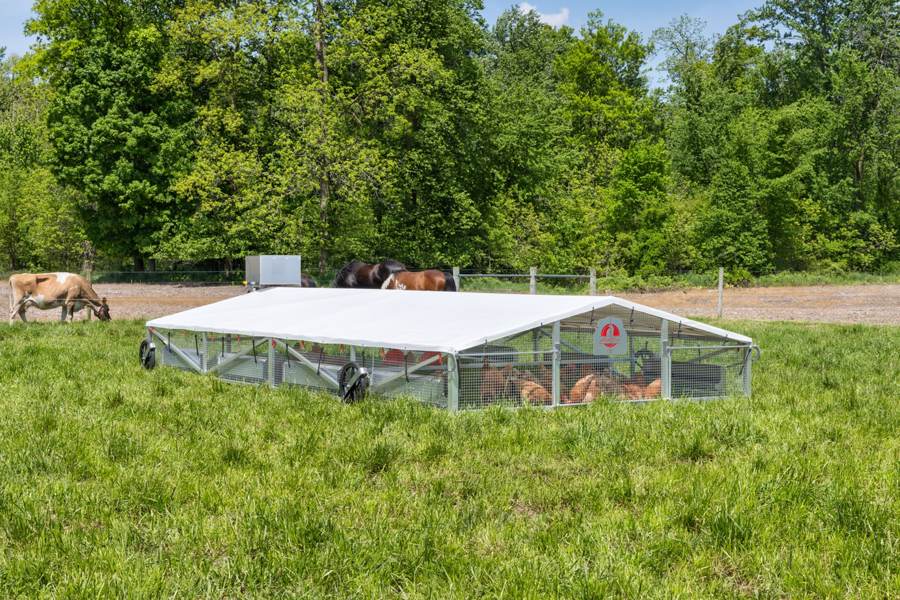
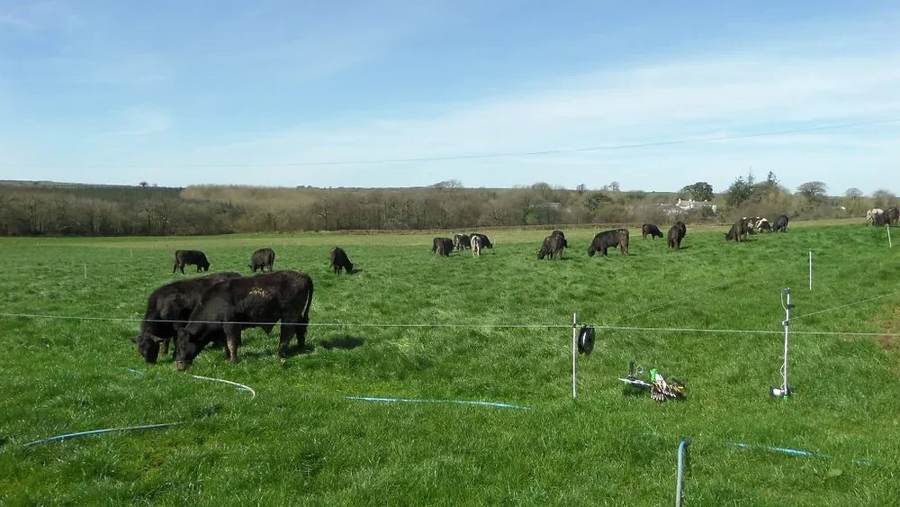
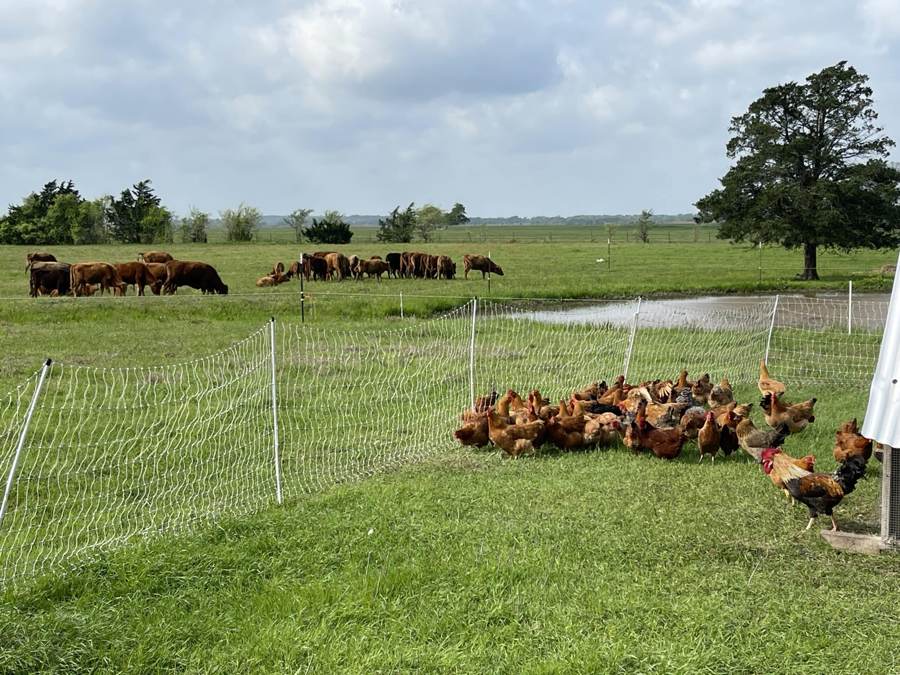
Cattle go first, since they’re built to harvest the tall, high-energy top layer of forage. Once they’re moved off a paddock using portable electric polywire fencing, chickens or pigs follow behind them, since chickens in particular prefer grass that’s already been grazed down to a short two-to-three-inch height.1 That sequencing isn’t incidental — it’s the whole mechanism that makes the system work without chemical inputs.
What the chickens do next matters just as much as when they arrive. As they forage through the paddock, they aggressively scratch apart the manure patties cattle leave behind, hunting for fly larvae and grubs. In the process, they spread that manure’s nutrients evenly across the pasture instead of leaving it in concentrated piles, and they interrupt the life cycle of internal parasites that would otherwise re-infect the cattle — accomplishing with chicken behavior what a chemical dewormer would otherwise be needed for.2
The Output: Better Health, Richer Pasture, Drought Resilience
The payoff from this system compounds over time rather than showing up all at once.
The most important long-term change happens underground. Continuously grazed pasture never lets plants fully recover — grazed again and again before they can regrow, their root systems stay shallow and weak. Rotational systems that give paddocks real rest between grazing periods let roots push much deeper into the soil, which builds soil organic matter and dramatically improves the land’s ability to hold water. The practical result: pastures that stay green and productive through dry spells that would leave a continuously grazed field brown and bare.3
Multi-species grazing also solves a weed problem most homesteaders fight constantly. Because different animals have different grazing preferences — cattle favor tall grasses, small ruminants like sheep or goats go after brush and weeds, pigs root out invasive plants at the source — running more than one species through a pasture keeps any single unpalatable plant from taking over. The result is a more diverse pasture with higher crude protein and better digestibility across the board.1
Getting Started: The One-Paddock Blueprint
The single biggest reason homesteaders never start rotational grazing is the assumption that it requires major infrastructure — permanent fencing, expensive water systems, dozens of acres. It doesn’t. The whole point of the method is that it scales down to a backyard as easily as it scales up to a ranch.
| Component | Action Step for Homesteaders |
|---|---|
| Infrastructure | Skip permanent fencing entirely. Invest instead in lightweight, portable electric netting or polywire, fiberglass step-in posts, and a solar energizer — all of it reusable and relocatable. |
| The starting unit | Begin with one mobile paddock: a small flock of poultry in a mobile chicken tractor, or two to three small ruminants like sheep or goats. |
| Move frequency | Commit to daily or every-other-day moves. Follow the rule of thumb: take half, leave half — leave enough plant residual behind that the grass can photosynthesize and recover quickly. |
Once that single paddock is running smoothly, adding a second species behind the first — chickens following goats, for instance — is a natural next step rather than a system redesign.
Paddock Dimensions & Stocking Densities: 1-Acre vs. 5-Acre
When shifting from theory to practice, the biggest hurdle for homesteaders is calculating spatial layouts. Below are specific blueprints for a 1-acre micro-homestead and a 5-acre small farm using intensive rotational grazing.
The 1-Acre Micro-Homestead Layout
Total area: 43,560 sq. ft. (approx. 208 ft. × 208 ft.)
On a single acre, space is at a premium. Large ruminants like full-size beef cattle are generally impractical year-round. Instead, the focus should be on micro-livestock and poultry stacking to maximize biomass conversion without destroying the root systems.
Recommended stocking density (choose one combined mix):
- Option A — Poultry only: 75–100 meat broilers (in mobile tractors) + 15–20 laying hens.
- Option B — Mixed micro-ruminant: 2 standard sheep or 3 Nigerian Dwarf goats + 10–12 laying hens.
Paddock dimensions & rotation schedule: To give the grass a necessary 30-day rest period to regrow, divide the open pasture into six distinct paddocks using portable electronet.
- Paddock size: approx. 7,260 sq. ft. each (e.g., 60 ft. × 121 ft.).
- Move frequency: every 5 days.
- The rotation: 5 days per paddock × 6 paddocks = a 30-day total rotation cycle, giving Paddock 1 a full 25 days of rest before the animals return.
The 5-Acre Small Farm Layout
Total area: 217,800 sq. ft.
A 5-acre footprint unlocks the true potential of the multi-species “leader-follower” stacking method — enough ecosystem buffer to run cattle ahead of poultry or small ruminants.
Recommended stocking density (stacked simultaneously):
- Leader (Group 1): 2–3 beef steers, or 2 cow-calf pairs.
- Follower (Group 2): 4–6 sheep or goats, to clean up weeds and brush the cows ignore.
- Sanitation (Group 3): 50–75 laying hens in a mobile egg mobile, or 150 meat broilers.
Paddock dimensions & rotation schedule: for 5 acres, a 15-paddock system using flexible, temporary polywire fencing offers the best control over forage consumption.
- Paddock size: approx. 14,520 sq. ft. each (approx. 100 ft. × 145 ft.).
- Move frequency: every 2 days.
- The rotation: 2 days per paddock × 15 paddocks = a 30-day total rotation cycle, guaranteeing 28 days of uninterrupted rest per paddock — enough for forage to rebound to its maximum nutritional state.
Quick Reference: 1-Acre vs. 5-Acre
| Feature | 1-Acre Homestead | 5-Acre Small Farm |
|---|---|---|
| Primary livestock | Poultry, rabbits, or 2–3 miniature goats | 2–3 cattle, 4–6 sheep, 100+ poultry |
| Fencing type | Portable electric electronet (poultry/goats) | Single/double-strand polywire with step-in posts |
| Number of paddocks | 6 | 15 |
| Paddock size | ~7,260 sq. ft. | ~14,520 sq. ft. |
| Rotation speed | Every 5 days | Every 2 days |
| Target rest period | 25 days | 28 days |
The Faith Angle: Honoring the Divine Design and Cycles
None of this is only a technique for better forage. It’s also a way of taking seriously what Scripture says about the creatures under our care.
Christian theological tradition has long insisted that animals carry inherent value because they, too, reflect something of their Maker’s glory. John Calvin argued centuries ago that human dominion over animals comes with real limits — a conditional responsibility to handle creatures gently and honor the dignity God built into them, not a blank check to treat them however is most convenient.4 Confinement systems that never let an animal move, forage, or behave the way it was designed to behave sit uneasily against that tradition, whatever their efficiency.
This is precisely the ground Salatin has spent decades standing on. His repeated point is that industrial confinement farming sins against the Creator’s design by treating living, breathing creatures as interchangeable biological machines rather than as what they are.7 Rotational grazing, by contrast, lets a cow behave like a cow and a chicken behave like a chicken — foraging, scratching, moving, resting — rather than forcing them into a system built purely around output.
There’s a deeper rhythm here too. The paddock-rest cycle at the heart of rotational grazing — graze hard, then rest long — echoes the sabbath pattern woven through Scripture from the very beginning: work and rest, use and renewal, death and regeneration built into the land itself. A pasture that’s never allowed to rest eventually breaks down, just as a person or a people who never rest eventually do. Short-duration grazing followed by long recovery isn’t just good agronomy; it’s a pattern of life and rest that Scripture assumes is built into creation from the start.
A Practical First-Month Action Plan
- Fence one small paddock. Use portable electric netting or polywire — no permanent infrastructure required.
- Choose your starting species. A small flock of chickens in a mobile tractor is the lowest-cost, lowest-risk entry point for most homesteads.
- Move daily or every other day. Watch the grass, not the calendar — move sooner if it’s being grazed too hard, later if there’s still plenty of residual.
- Apply the take-half-leave-half rule. Never graze a paddock down to bare dirt; leave enough leaf material for fast regrowth.
- Add a second species once the first rhythm feels manageable. Let cattle or larger ruminants lead, with poultry following a few days behind to sanitize and fertilize.
Conclusion: A Pattern Older Than the Method
Rotational grazing looks, on the surface, like a clever modern management technique — better forage, healthier animals, less parasite pressure, more drought resilience. All of that is true. But underneath the technique is something much older: a pattern of work and rest, of honoring a creature’s design rather than overriding it, that Scripture assumed long before anyone called it “regenerative agriculture.” Whether you’re managing three goats on a half-acre or three hundred head across a working ranch, the underlying call is the same — let the land rest, let the animal be what it was made to be, and watch what grows back.